
Retailers would be eager to welcome the holiday season since it is a chance for them to boost sales and increase revenue. Planning and preparation goes on well ahead of the holidays to ensure enhanced customer experiences. But it is not sufficient. You need to be equally prepared for the post-holiday season to meet the surge in returns and exchanges.
This blog post highlights challenges in managing returns and exchanges, a few simple tips for handling post holiday returns, and benefits of a streamlined returns process.
Table of contents
- Why post-holiday returns surge
- Common challenges in managing returns & exchanges
- Best practices to handle returns efficiently
- Benefits of a streamlined return process
- How Gofrugal helps handle returns and exchanges
- Frequently askes questions (FAQs)
Why post-holiday returns surge
The retailers will be busy not only during the holidays, but also for a few weeks post-holidays, not because of sales now but due to returns and exchanges. Although returns and exchanges are common, the period after the holidays sees a surge in returns for the following reasons.
- Wrong choice of items: The color, size, and variation does not suit the buyer or does not match the taste of the person who was gifted the item, especially if bought through an ecommerce website or without trying on or trying out the product, which causes increased returns.
- Impulse buying: Many customers buy items during the holidays influenced by others and to take advantage of discounted prices and offers even if there is no need for those items. Once the interest fades away, they return the items.
- Quality or damage issues: Due to bulk procurement and stocking at warehouses before the holidays, items may get damaged which can be bought by customers without noticing. The items can also be damaged after buying during the logistics. In both cases, returns and exchanges happen and are higher than usual after the holidays.
Common challenges in managing returns & exchanges
- Handling used items: For items partially used or opened before return, verifying item condition and validating the legitimacy of returns is difficult. It is also hard to store items safely without further damage for supplier checks and reselling these items.
- Mismatched inventory: It takes time to verify the item condition, make an entry, and update the returned stock, resulting in stock mismatch. Delayed inventory updates result in poor purchase planning, untimely replenishment, and frustrated customers.
- Increased fraud: Customers can return counterfeit items, old items bought before the return window, and items bought elsewhere which causes potential loss if not handled with proper checks.
- Increased workload: The higher the returns, the higher the load on staff to verify, validate, segregate, and process return requests. For businesses with multiple outlets and an ecommerce presence, the load increases, keeping them from focusing on other tasks.
- Customer experience struggles: Return and exchange processes should be as seamless as billing processes to provide pleasant customer experiences. Delayed return processes due to manual operations, outdated technology, and a lack of preparation can cause customer frustration, higher churn, and revenue loss.
Best practices to handle returns efficiently
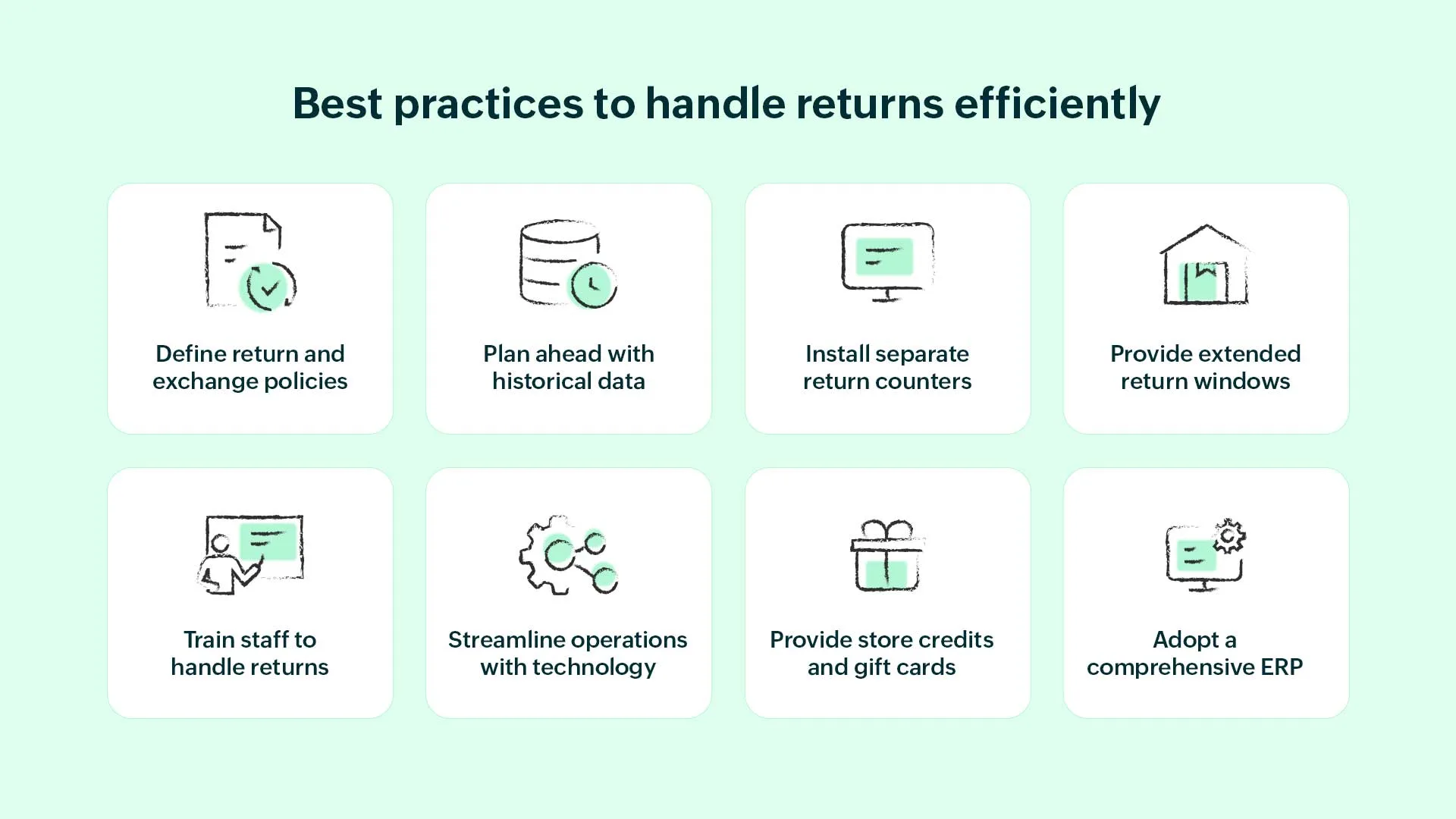
- Define return and exchange policies: Prepare clear and easy-to-understand return and exchange policies and specify special terms and conditions, if applicable. Display the policies transparently near checkout counters in the store and before the checkout page on ecommerce websites to reduce confusion.
- Plan ahead with historical data: Analyze the previous year data, interpret patterns, identify your most returned and exchanged items, and plan your inventory accordingly. Dive deep into the common reasons for returns and exchanges in the past and take corrective actions to reduce the return rate.
- Install separate return counters: Have dedicated counters for billing and returns to ensure a seamless customer experience. Provide access to relevant screens in return counters to make entries, view the updated stock, and look for alternate items to cross-sell to customers.
- Provide extended return windows: Enable customers to return or exchange items after a long period from the purchase date, after the holiday season to reduce the anxious rush to return and the subsequent overcrowding. Extended return windows also allow you to review the sales and current inventory, organize items, and refill sufficient stock.
- Train staff to handle returns: Educate staff on return and exchange policies, and software usage. Equip them on customer service to handle all scenarios at counters with empathy. Train them to segregate the returned items quickly based on quality to decide the next actions and update the stock.
- Streamline operations with technology: Implement POS software with barcode and hardware integrations for accurate tracking. Link returns to sales bills and customer profiles to analyze patterns later. Set return value thresholds and configure automatic approvals.
- Provide store credits and gift cards: Prioritize exchanges to avoid revenue loss and regain customer trust. Ensure repeat walk-ins and customer loyalty by offering gift vouchers and store credits with extended validity.
- Adopt a comprehensive ERP: Implement omnichannel ERP that lets you manage sales and purchase operations, handle returns at any store with complete visibility, and generate credit and debit notes. It should let you view a complete history of returned items, view real-time stock, and ensure a seamless return and exchange process.
Benefits of a streamlined return process
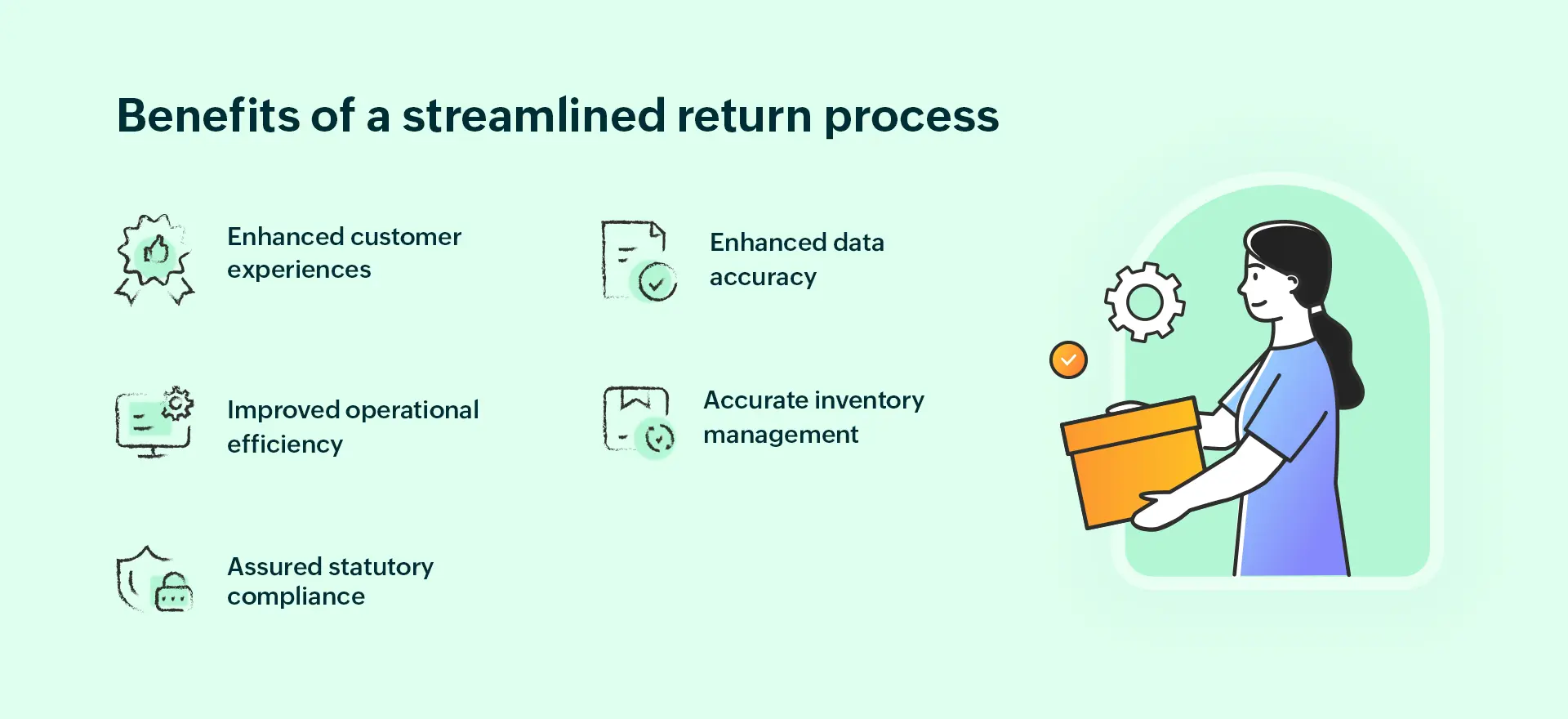
- Enhanced customer experiences: A well organized return process ensures hassle-free returns, quick checkouts, and reduced waiting time for customers, ensuring customer satisfaction and brand loyalty.
- Improved operational efficiency: Streamlined and automated return processes reduce manual work, reduce time, and improve overall efficiency and staff productivity, allowing your staff to focus on other priority tasks in the store.
- Accurate inventory management: Digitized return management to record returned stock in real-time ensures accurate inventory levels, helping optimize reordering, stock replenishment, and sales planning.
- Enhanced data accuracy: Adopting POS software for returns management minimizes manual typos and data entry errors, automates stock entries, and increases data accuracy.
- Assured compliance: Efficient returns management with ERP software ensures real-time data posting in accounting ledgers and automated adjustments, assuring GST and financial compliance.
How Gofrugal helps handle returns and exchanges
- Hassle-free refund management: Generate return redemption notes (RRNs) for refunds and adjust the amount in the next customer sales bill easily.
- Smooth exchange management: Process exchanges for items like electronics and utensils based on current asset value and adjust the exchange cost in new orders.
- Real-time inventory sync: Adjust the inventory in real time for returned items, generate credit notes, and ensure automatic posting in accounting ledgers.
- Streamlined customer credits: Track and manage customer advances and credits efficiently, apply them in future transactions, and send updates on WhatsApp or SMS.
- Easy customizable shortcuts: Switch effortlessly between billing and return screens using easy, flexible, and user-defined shortcut keys.
Frequently asked questions
1. What is the best way to manage multi-outlet returns?
The best way to manage multi-outlet returns is to centralize operations linked to returns such as inventory, purchase, loyalty, and customer relationship management. It ensures consistent experiences, instant stock visibility across locations, flexible refund processing, and accurate decision-making.
2. How can retailers speed up the return and exchange process?
Retailers can speed up the return and exchange process by implementing the following:
- Allow flexible returns and exchanges at any store or online.
- Install dedicated counters for returns and exchanges.
- Implement batch-wise barcode for all items.
- Adopt ERP software to handle all operations from billing and purchasing to returns.
- Train staff on software and educate them on return and exchange policies.
- Draft clear, easy-to-understand return and exchange policies.
3. How do POS systems help handle refunds and exchanges easily?
POS systems help handle refunds and exchanges easily because it:
- Helps verify the original bill, supplier details, manufacturer details, batch details, and other details of transacted items instantly with a simple barcode scan.
- Allows you to record returned stock, adjust inventory for returned items in real time, and generate credit and debit notes.
- Enables you to retain customers and influence them to buy from you again by offering store credit, gift vouchers, and return redemption notes (RRNs) to use during future purchases.
- Empowers you to ensure tax and statutory compliance through automated posting in accounting ledgers.
- Records holistic data allowing you to analyze patterns, negotiate with suppliers for quality, identify fraud, and make informed business decisions.
4. How can businesses turn returns into customer retention opportunities?
Businesses can turn returns into customer retention opportunities by:
- Offering store credit and gift vouchers with a validity period nudging them to return to your store again.
- Providing seamless experiences at counters during returns, making the journey memorable and ensuring repeat purchases.
- Sending real-time updates of return requests and personalized thank-you messages on WhatsApp or SMS to keep reminding them of your brand.
- Asking questions about the reason for returning items, providing an opportunity to analyze what went wrong and also build customer trust.
- Generating return redemption notes (RRNs), influencing customers to walk in again and make purchases to use their RRN balance.
5. How can automation improve the refund and exchange experience?
Automation in the returns and exchange process improves the overall customer experience as it:
- Automates key processes, minimizes human errors, and reduces staff workload.
- Reduces time consumed to process returns and provides quick checkout experiences.
- Ensures tax and financial compliance with accurate posting in accounting ledgers.
- Provides transparency and ensures accurate consistent data across the supply chain.
- Updates inventory in real time ensuring precise purchase decisions and reliable stock levels.
6. Why should retailers use Gofrugal POS for post-holiday returns?
Gofrugal POS has a wide range of features that allows retailers to run their business efficiently. Gofrugal ERP, with comprehensive sales, purchase, and inventory management, allows you to handle post-holiday returns effortlessly.
- Provide consistent experiences across outlets with multi-store POS software to handle all operations centrally with real stock visibility.
- Track all damaged and expired items returned to the store with dedicated damage entries, immediate stock adjustment, and automatic posting in accounting ledgers.
- Arrest frauds and thefts with role- and user-based restricted access controls to allow access to only relevant screens.
- Generate credit notes and debit notes for returned items and return redemption notes (RRNs) for use during future purchases.
- Customize keyboard shortcuts based on flexibility and easily toggle between billing and return screens.
The post-holiday returns surge is inevitable and overwhelming to manage but with the right tools and technology, you can convert operational challenges into growth opportunities. Implementing comprehensive ERP software like Gofrugal can help simplify return processes, streamline inventory management, ensure accuracy and reliability in operations, and scale your business effortlessly.