How to calculate a restaurant's or bakery's profit margin?
Profit margin indicates how much revenue remains as profit after accounting for all expenses. Unlike other businesses, tracking the profit margins in food business is crucial to maintain a profit considering multiple revenue leaks through waste, overhead expenses, and hidden costs.
Try Gofrugal
Highly rated and trusted by customers!








Key features
Key takeaways
- Why profit margin accuracy matters.
- How to calculate gross and net margins step by step.
- Explore challenges in margin tracking and how to solve them.
Common mistakes owners make in calculating profit margins
- Skipping recipe costing and portion control.
- Copying competitor prices without considering actual costs.
- Relying on manual calculations instead of data-driven insights.
9 Steps to calculate your restaurant’s profit margins
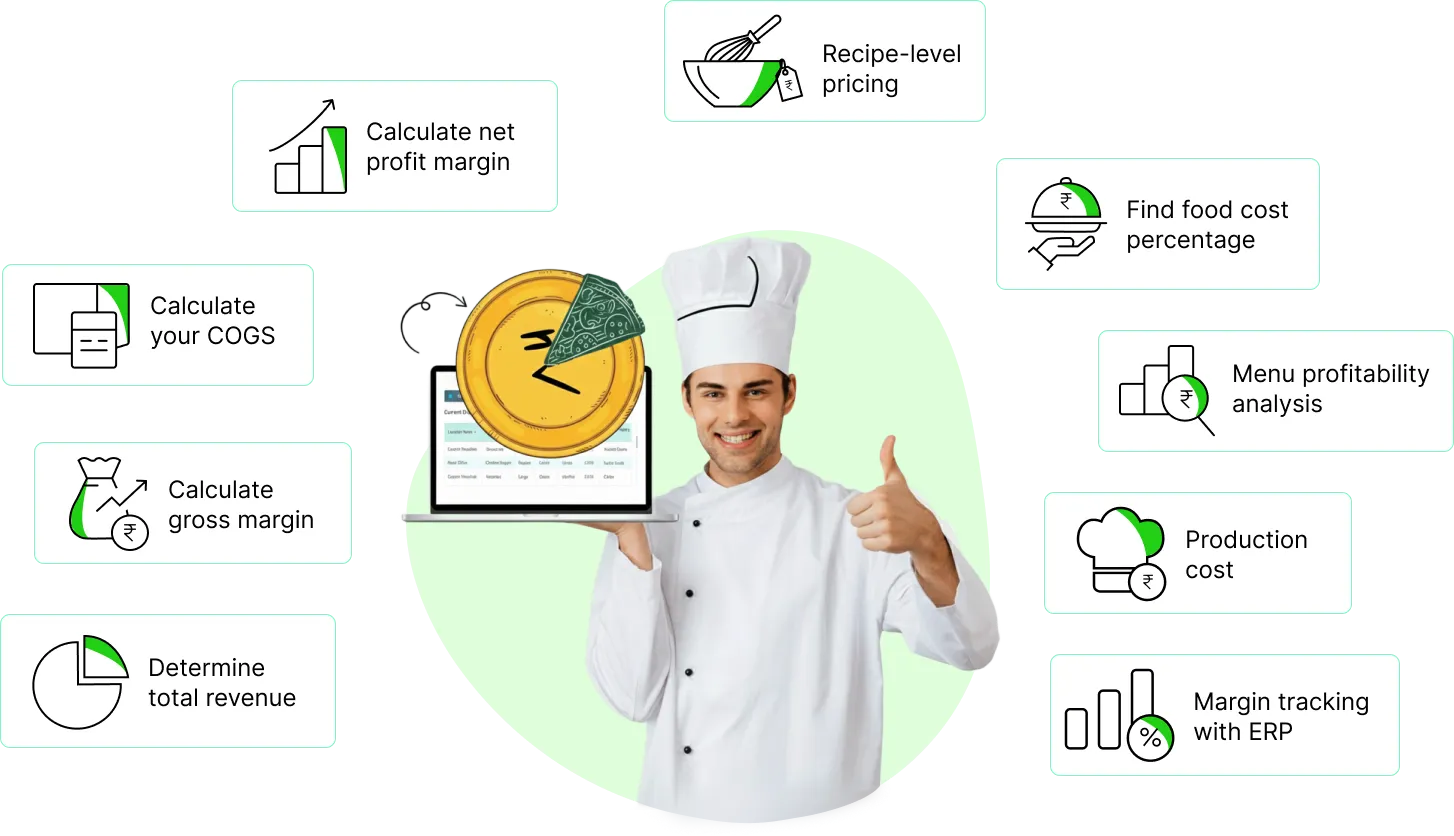
Let’s walk through an example of a bistro with ₹10,00,000 monthly sales.
1. Determine your total revenue
Your total revenue is the sum of all sales from food, beverages, and bakery items during a given period.
- Example: Smart POS reports show total monthly sales at ₹10,00,000.
- With Gofrugal: Get revenue insights instantly through smart reports and track performance across outlets in real time via the mobile app.
2. Calculate your cost of goods sold (COGS)
COGS tells you how much you spent on ingredients used to make the food sold.
- Formula: (Beginning Inventory + Purchases) – Ending Inventory
- Example: ₹2,00,000 (beginning) + ₹4,00,000 (purchases) – ₹1,50,000 (ending) = ₹4,50,000 COGS
- With Gofrugal: Automated stock and purchase management ensures accurate COGS calculation with no manual errors.
3. Basic gross margin formula
This shows how much profit remains after covering ingredient costs.
- Formula: (Revenue – COGS) ÷ Revenue
- Example: (₹10,00,000 – ₹4,50,000) ÷ ₹10,00,000 = 55% gross margin
- With Gofrugal: Track gross margins in real time through centralized dashboards for instant visibility.
4. Net profit margin formula
This reflects your true profit after deducting rent, salaries, electricity, utilities, and all other expenses.
- Formula: (Revenue – All Expenses) ÷ Revenue
- Example: ₹10,00,000 – (₹4,50,000 + ₹3,00,000) = ₹2,50,000 → 25% net margin
- With Gofrugal: Our system integrates expense tracking with revenue data, giving you an accurate net margin snapshot instantly.
5. Recipe-level pricing
Each dish or bakery item should be priced individually to avoid underpricing and manage portion sizes.
- Example: A pizza selling for ₹300 costs ₹120 in ingredients → Profit = ₹180 (60%)
- With Gofrugal: Use integrated recipe and production management to automatically calculate per-dish profitability.
6. Find your food cost percentage
Food cost percent shows how much of your revenue is spent on raw materials.
- Formula: COGS ÷ Revenue × 100
- Example: ₹4,50,000 ÷ ₹10,00,000 × 100 = 45% food cost. (Target: 28–35%)
- With Gofrugal: Real-time food cost reports highlight problem areas so you can act before costs increase.
7. Menu profitability analysis
Not all menu items are equal; some generate high margins, others drain profits.
- Example: Pizza (60% margin) vs. Pasta (25% margin)
- With Gofrugal: Our menu engineering tools show which dishes are high performers and which need recipe or price adjustments.
8. Batch/production cost (for bakeries)
Bakeries need to track cost and profitability per batch since production runs are high-volume.
- Example: 100 loaves cost ₹5,000 to make, sell for ₹8,000 → Profit = ₹3,000 (37.5% margin)
- With Gofrugal: Production and batch costing modules automatically calculate per-batch profitability with ingredient and labor data.
9. Real-time margin tracking with ERP
Margins shouldn’t be calculated once a month, they need to be tracked continuously.
- With Gofrugal: Our ERP syncs sales, purchases, and stock movement to update margins instantly, giving owners complete visibility to act on time.
- Conclusion from Example: With ₹10,00,000 revenue, the restaurant achieves a 25% net profit margin. By tracking at each step, hidden costs and low-margin items are exposed, giving owners clarity to improve profitability.
How can Gofrugal help solve this complex challenge?
By using an integrated restaurant management system, such as Gofrugal, to manage inventory, POS, accounting, and labor management facilitates efficient data collection and perform in-depth analysis to maximize the profits. With Gofrugal, you can:
- Perform frequent inventory audits Regular and consistent inventory counting to achieve correct COGS calculations.
- Standardize recipes and portion control Employ accurate measurements and training in order to standardize the use of ingredients and reduce waste.
- Emphasize menu engineering and strategic pricing Examine menu item costs and popularity to best price and position items for maximum profitability.
- Initiate proactive cost management initiatives Enact cost-saving initiatives in areas like energy efficiency, supplier negotiations, and labor scheduling.