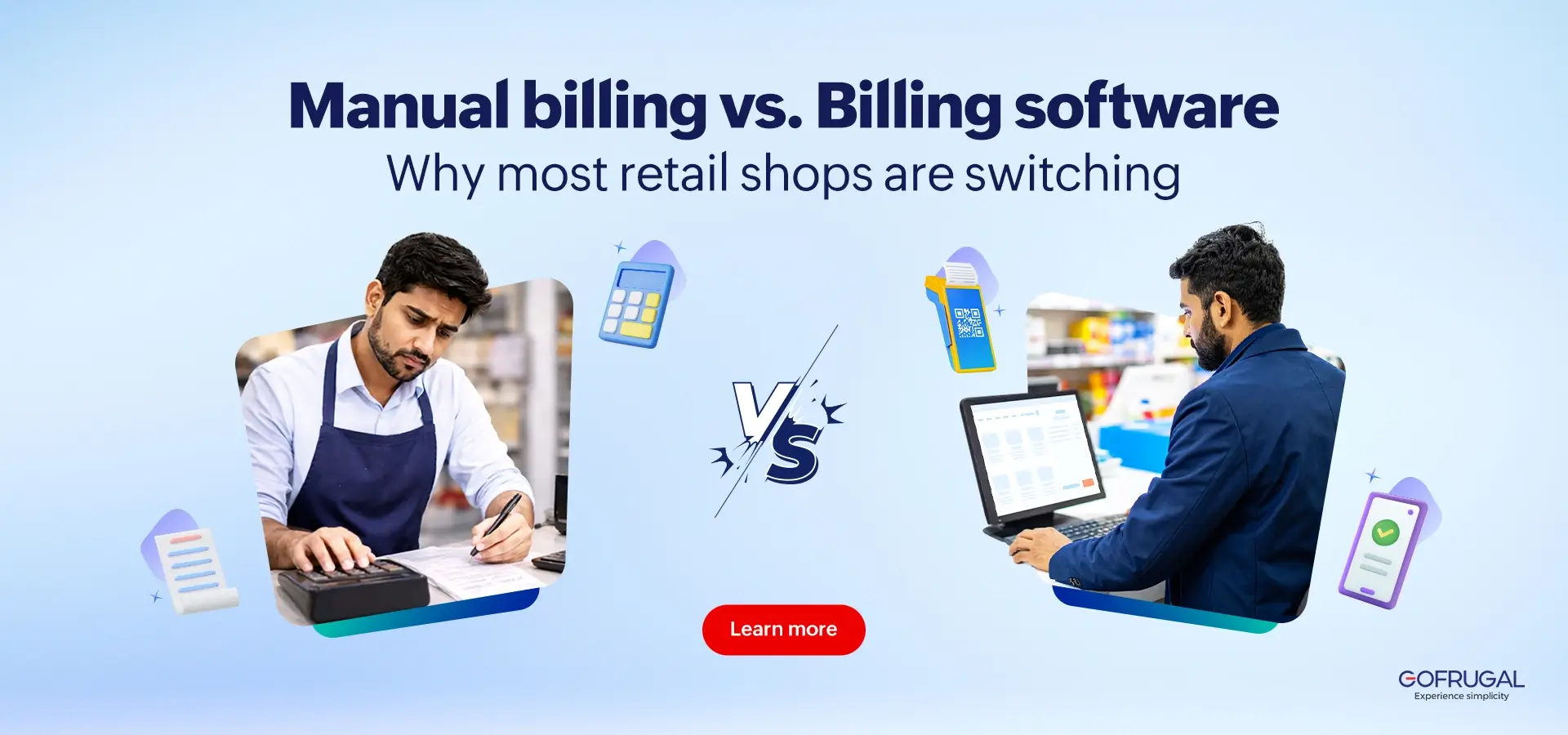
Retail industry and the importance of billing
The Indian retail industry accounts for over 10% of the country's GDP and employs approximately 8% of the workforce. It is one of the fastest-growing markets globally, ranked as the fourth-largest in the world. These stats give an idea about how big the retail industry is and how important its operations are. One of which is billing, the crucial yet often less automated task in operations.
Billing accounts to the complete cash flow in any retail business and errors in it would lead to complete financial collapse in the business. One of the best ways to stop this issue is by adopting an intelligent and automated billing software.
What is manual billing?
Manual billing or traditional billing is the method in which retailers or cashiers use handwritten bills for items along with quantities and costs on a piece of paper and hand it to the customers. This type of billing can be seen in small retail stores, local grocery shops, and any shop that is simply used to this process. Although it may seem to work well for the business at the moment, this method won't work when the business scales to a certain level and includes critical operations.
Challenges of manual billing
Time-consuming
Manual billing requires the careful checking of items, their quantities, and their current selling price before writing out the bill. This method is not only error prone but also heavily time-consuming and makes customers wait for a longer time to checkout and leave.
Prone to errors
Mistakes in item counting, change in the selling price, and leaving out an item during total tender calculation are the common errors in manual billing. These issues lead to revenue loss in the long run.
No real-time data
Manual billing does work for billing items and collecting cash in small businesses, but it does not help check the real-time sales data, stock visibility, daily performance, and other insightful business data. Everything in this method relies on end-of-day cash and stock calculation.
Limited scalability and visibility
As a business expands, it becomes increasingly difficult to manage manual processes. Monitoring various products, personnel, or transactions without an organized system can swiftly become burdensome.
What is billing software?
Billing software is a digital tool used to manage the entire billing process of a business by automating invoice generation and generating sales bills. Billing software can also help retailers by generating bills instantly; automatically calculating totals, taxes, and discounts; tracking inventory in real time; and managing multiple payment modes (cash, UPI, cards).
Manual billing vs. Billing software
| Aspect | Manual billing | Billing software |
| Speed | Slow, especially during peak hours | Fast, instant bill generation |
| Accuracy | High chance of human errors | Automated, error-free calculations |
| Inventory tracking | No real-time tracking | Live stock updates with every sale |
| Reporting | Manual records, time-consuming | Instant reports and insights |
| Customer experience | Delays and billing confusion | Smooth, quick, and professional checkout |
Why should you switch to billing software?
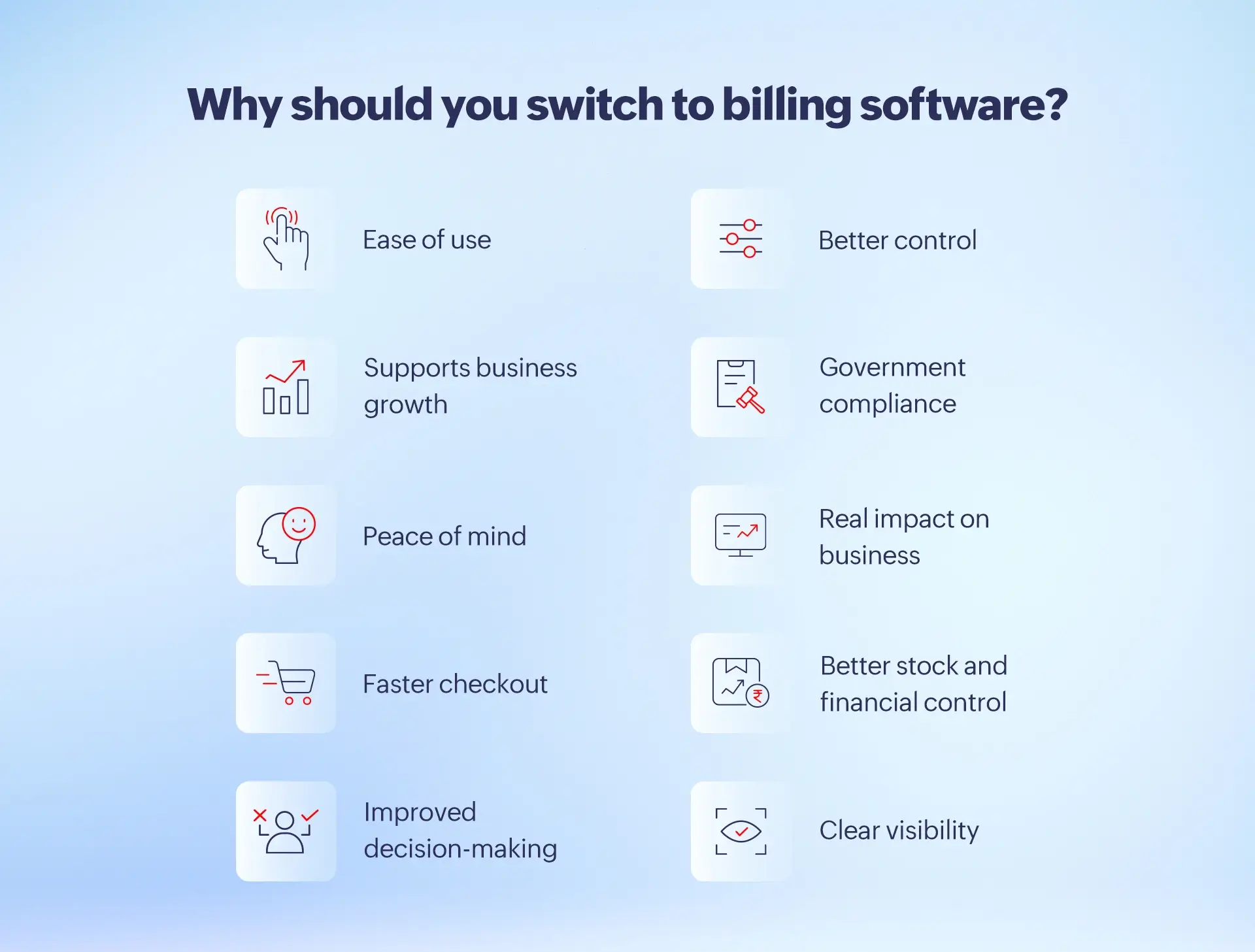
Many retailers postpone the decision to switch to billing software, hesitating because of the technological shift. But switching isn't just about technology, it’s about making everyday operations easier and more reliable.
- Ease of use: Modern billing software is designed to be user-friendly; you don’t need to be tech-savvy to use it.
- Better control: Know exactly what’s happening in your business at any moment. Get better control over:
-> Sales
-> Stock
-> Cash flow - Supports business growth: As your store expands, the system scales with you, without adding complexity.
- Government compliance: With GST and digital transactions becoming standard, billing software helps ensure:
-> Proper tax calculations
-> Organized records
-> Compliance with regulations - Peace of mind: Less dependency on manual work means fewer mistakes and more confidence in your operations.
- Real impact on business: Switching to billing software doesn’t just change how you bill, it transforms how your business runs.
- Faster checkout: Serve more customers in less time, especially during busy hours.
- Better stock and financial control: Always know what’s in stock and how your business is performing financially.
- Improved decision-making: With access to real-time data and reports, you can:
-> Identify top-selling products.
-> Reduce dead stock.
-> Plan better for growth. - Clear visibility: Every aspect of your business is trackable and measurable—no more guesswork.
Conclusion
Manual billing may have worked in the past, but the retail environment has evolved to a point where increased speed, accuracy, and monitoring are necessary.
Making the move to billing software is not a major change, but rather a natural step in the development of a business that wants to grow, stay competitive, and run efficiently.
The sooner you make the change, the sooner you will be able to enjoy the benefits.
Take the next step
If you are looking for a way to streamline your business and take control of your retail business, it may be time to think about a more intelligent solution.
An intelligent billing software program like Gofrugal does more than replace your existing system; it allows you to run your business more effectively every single day.